Friday, April 24, 2020

LV 640

Along with finishing up a number of freight car projects and some miscellaneous items, I've also been working on some new power for the railroad. Lehigh Valley C628 640 has been weathered and placed in service. This unit has been leased from Conrail in order to alleviate the power shortage that has resulted from the tremendous increase in demand for coal.


I purchased this unit on sale a number of years ago with the intent of repainting it for the home road. But as I was getting rid of a number of old magazines recently, I came across the two-page color photo of 633 and 628 followed by two snowbirds in the June 2002 issue of Trains magazine which is shown below. The photo was taken in March of 1976- just five months before my time period. So not only did I have a period photo for weathering, but I also had both sides of the C628's. A little additional researched showed that 640 was an ex-Monon unit that was repainted into the Cornell Red scheme in 1974. And other than the end handrails, all of the details were correct. So the back story of leasing this unit was quickly developed and I went searching for additional photos.


About this time I remembered that Mike Confalone had done a Cornell Red LV unit in one of his weathering videos. Once I found that in my library, it was off the races. I used a number of the techniques that he covered in the video and also added a few of my own.


The unit was weathered with a combination of Pan Pastels, oils, acrylics and even a lead pencil. The weathering is the combination of the various effects I found on five different photos of LV C628's.


The weathering process involved a number of different applications of Pan Pastels followed by Dullcote followed by more Pan Pastels followed by... well, you get the point.


The last step was to scrape a #2 pencil along a small section of the upper front and rear handrails. In studying the photo, you could see where the crews had worn the paint off and what was showing was bare metal. From somewhere out of the blue, it occurred to me that I could represent this with pencil lead.

This unit will be teamed up with a home road C628 and SD45 in the not too distant future.


Sunday, April 12, 2020

Variations on a theme

Below is a shot of three loads that I captured at Stone Coal #2 at Summit Springs, WV. You can see three of the paint schemes that can be found on the hopper car fleet in 1976. The car on the left reflects the standard scheme introduced in 1966 for all new and shopped equipment. It features the large "CWE" herald, which also serves as the reporting marks, and the Central Belt logo on the right hand side of the car. The car on the right shows the standard scheme from 1958 until 1966. The car in the middle represents a recent rebuilt with a simplified scheme- smaller "CWE" herald and no Central Belt logo. Note also the plates that have been welded along the bottom of the car. This car was shopped in April of 1975 and the simplified scheme represents both a car whose days are numbered and the railroad's efforts to get it back into service as quickly as possible.


These variations in paints scheme are a great way to add some history to the railroad.

Friday, April 10, 2020

More Details- 1

About a month or so ago, I assembled and painted 12 of the Micro Engineering switch stands. My latest trick is to drill the stand for the target and then glue the target on using canopy glue. When, and not if, the stand gets bumped, the target will fall off the machine. In the past, I used two-part epoxy to glue the targets and when they got knocked off, the base of the target broke off. The canopy glue is weak enough that it won't stand up to a good bump, and as an added benefit, it dries clear.

So with some extra basement time these days, I decided to put together another batch. The photo below shows the stands installed at the west end of Hollister Yard. 


The next photo shows them installed on the leads to the engine service area and the coal yard. These are Details West switch stands which have a slightly smaller target. 


With the addition of these last few switch machines, all of the turnouts in Hollister Yard are now properly marked.

I had a few left over after finishing Hollister Yard so I installed them at the east end of Nelsonville, as can be seen in the photo below.


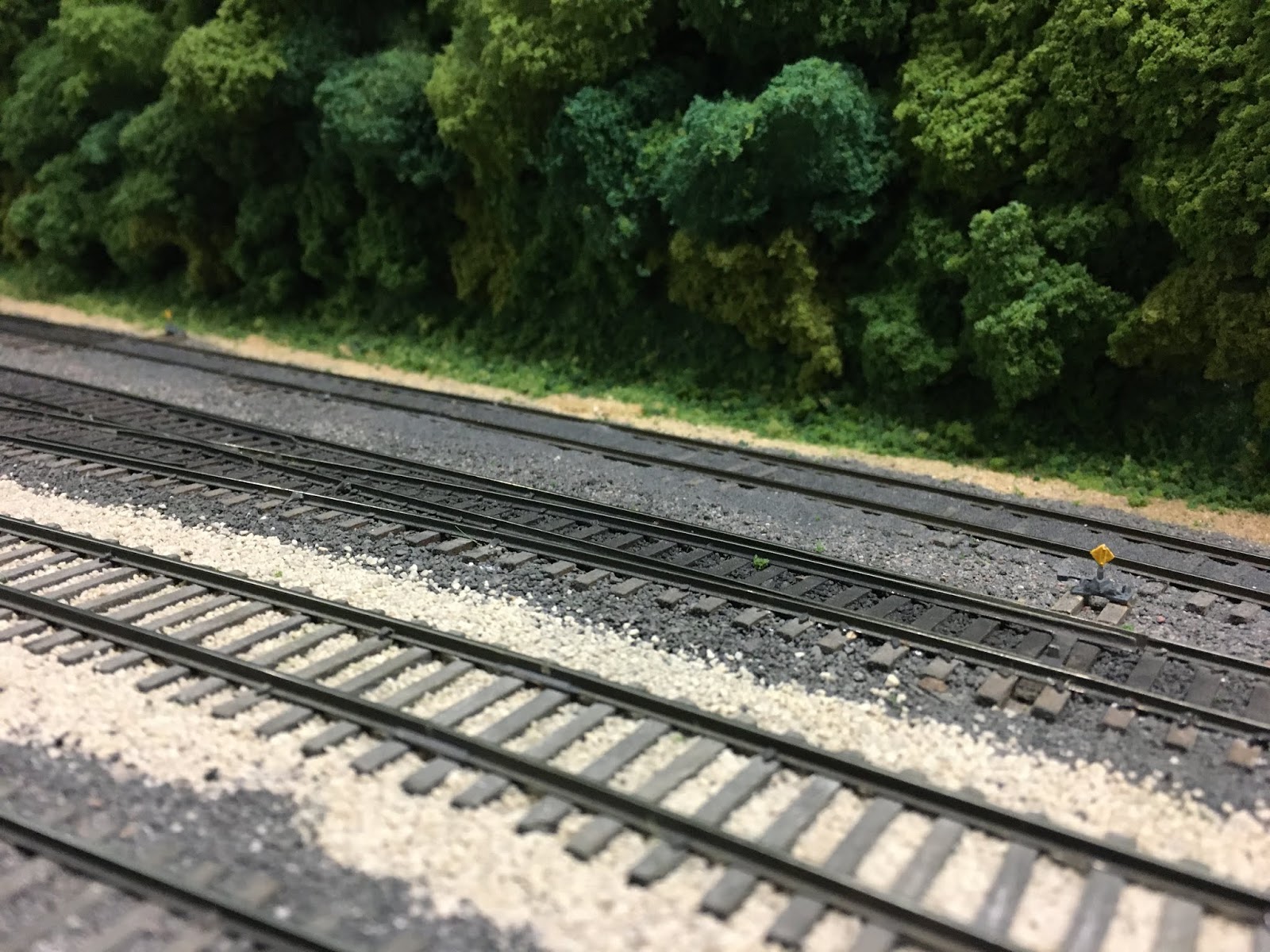
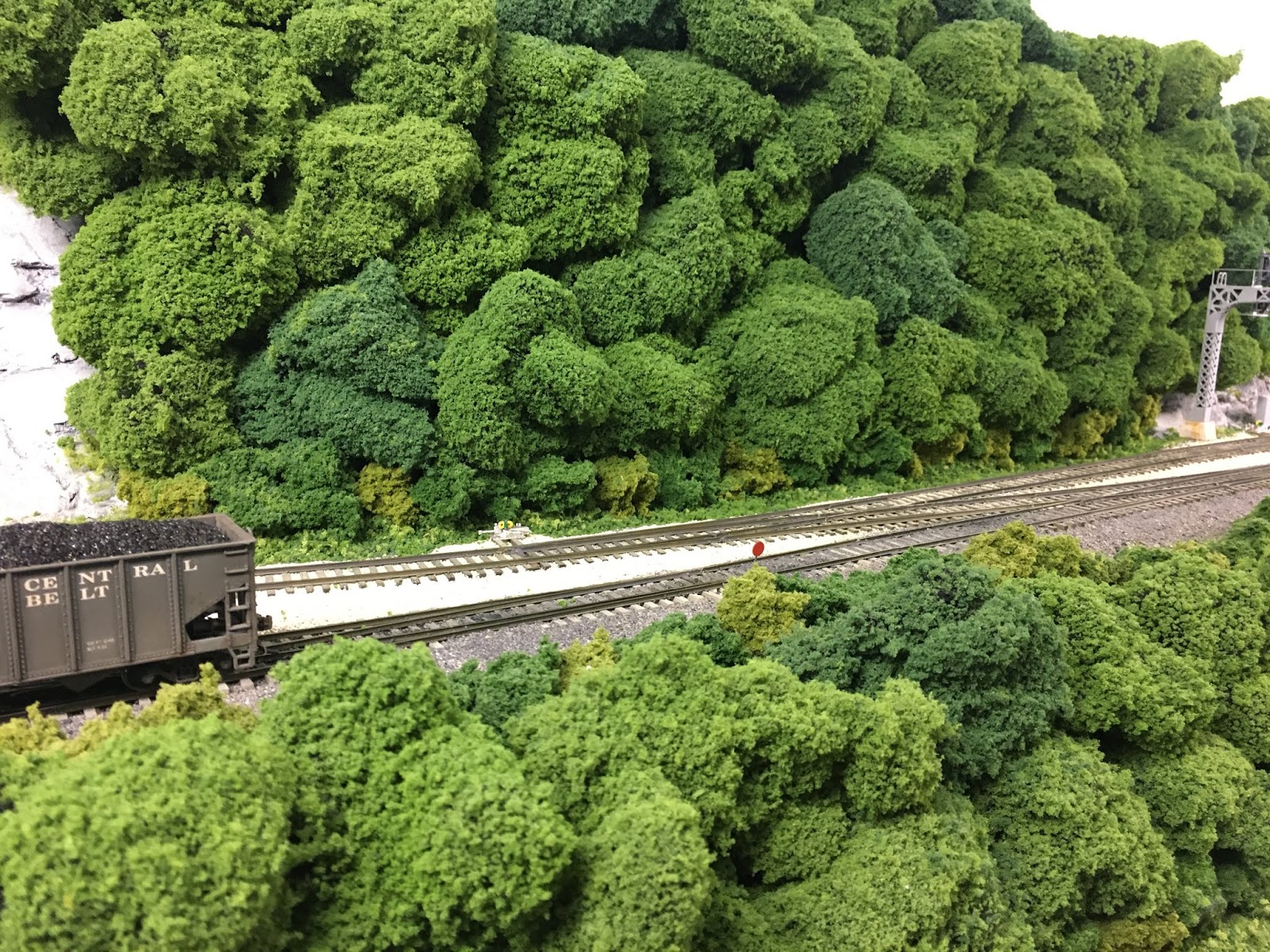
The past several times that I have staged the Laurel Ridge prep plant at Summit Springs, I have noticed that it's difficult to see where the points are for the first turnout to the mine. I started using a piece of foliage that sticks up right at the points as my "marker" for knowing when I had cleared the switch. I know that this was often done by crews on the real railroads, and there's a classic tale of an engineer shoving a cut of hopper cars off the end of a tail track because someone had cut down the large bush that he used for knowing when to stop shoving. At the Laurel Ridge plant, it occurred to me that I could install a high switch stand that would be visible above the foliage. The photo below shows the Central Valley switch stand that now marks the points.


And here's a view more typical of what the crews see when working the mine.


Hopefully, the new target will make working the prep plant just a little bit easier.

Monday, March 30, 2020

CWE Cab Ride

As I mentioned in a previous post, Greg McComas stopped by last month for a visit. He brought along his GoPro camera and we shot a cab ride on the railroad. It begins at the engine terminal in Nelsonville and wraps up at the west end of North Pierce. Greg kindly loaded the video up to his YouTube channel so that I could post a link here.

https://www.youtube.com/watch?v=GlArolLdoXw&t=10s


Enjoy the ride, and thanks again, Greg!


Thursday, March 26, 2020

Finishing Stuff- Part 4

Progress continues to be made on all of the projects that were listed back in parts 1 and 3 of the Finishing Stuff series of posts. The two pulpwood flats that were kitbashed from old Athearn Blue Box gondolas and Tichy pulpwood flat ends have been completed. The photos below show the two cars.


The inspiration for these cars came from a C&O Historical Society magazine article on gons that were converted to pulpwood flats. The photo below shows the cars in revenue service during the most recent op session.


The Moloco SAL Fruit Growers Express car has finally been finished. It was weathered with artist's acrylics and Pan Pastels.


The roof of this car was weathered based upon the photo below by Richard Jahn.


And one of the home road covered hopper cars is finally getting weathered. I've used artist's oils and water soluble oils so far. 


With a lot of additional time on my hands now, I've started several other projects. There is a Bowser Alco C628 in the paint shop that will be decorated for the home road. It will paired with a LV C628 that is in the paint shop to be weathered. And of course, there are still plenty of freight car kits to build. It's times like these that make me extremely grateful for the wonderful hobby of model railroading.

Tuesday, March 10, 2020

The Bartizek Brake

When I originally drew up the track plan for the railroad, I had absolutely no operating experience. I had read a great deal about track planning for operation, though, including John Armstrong's legendary book. Fortunately, most of what I had laid out originally works pretty well and what didn't I was able to change without much trouble. Except maybe the original west end staging...

One of the design issues that became apparent once I began operating was the grade in the yard at Nelsonville. The entire yard is on a grade of about 1.25% westbound. While this didn't seem like a lot during the planning phase, it's just enough to make it difficult for certain locomotives to push long cuts of cars up the tracks. And with advent of extremely free rolling wheelsets, holding cars on the grade has become a challenge. The solution to the lack of power was to replace the aging SW1200's with a GP7. The solution to holding cars on the grade is the Bartizek Brake.

My good friend Bob Bartizek is the owner and superintendent of the Pennsylvania & Western, a beautiful 3-rail, O-scale layout depicting the Pennsylvania Railroad in the early 1950's. Bob recently replaced a large number of his hopper cars with more accurate, and more free-rolling, models. And during a recent operating session, it became apparent that these cars weren't inclined to stay spotted at any location that had even the slightest grade. So Bob began to think of a way to make "brakes" to hold them in place. He discarded all of the usual ideas for various reasons. Then he hit upon the perfect solution- a small dab of ACC on top of the rail. A small blob is just enough to hold the car but not enough to impair movement over the track. And it's clear, so it's almost impossible to see. But most importantly, it's virtually maintenance free!

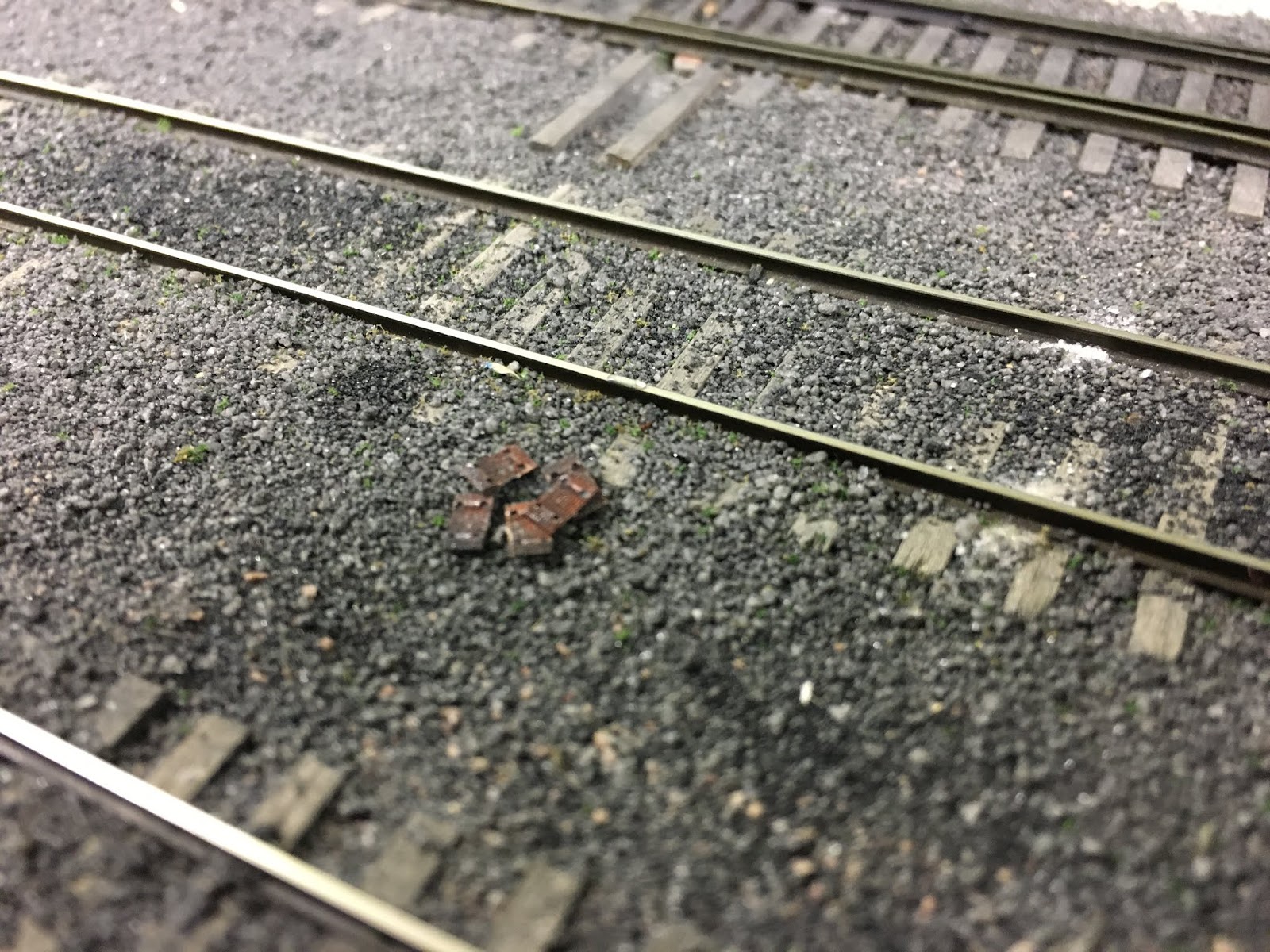
So armed with Bob's great idea, I finally had a solution to the brake problem at Nelsonville. The photo below shows the small dab of ACC on the rail near the west end of the yard.


Note the ties plates- the small blob is right above them. The tie plates will help the crews identify their locations (it's almost impossible to see them!). And there are "brakes" on one rail on each of the yard tracks and the siding at this location.

The next photo shows the brakes at mid-yard. A small piece of tie identifies the location of these brakes.


And the last brake is on the track near the east end of the yard. Once again, tie plates show the location.


These brakes are just a really great idea. No mess, no fuss, nothing to operate, easily replaced, almost invisible and work as advertised. Thanks, Bob! 

Wednesday, March 4, 2020

MCTR 728

Earlier this week, Greg McComas stopped by for a visit. He was in town for business and had some extra time, so we got together for some photo ops. More to come on that later.

Greg is the creator of the Michigan Interstate St. Clair subdivision and you can find his blog here: https://michiganinterstatemodelrr.blogspot.com/. More recently, he has been posting updates to Facebook on the Michigan Interstate St. Clair Subdivision page. He has done a wonderful job of creating the backstory for his railroad and he is quite an accomplished modeler. As we both are followers of the proto-freelanced movement, we have been trading information and discussing possible run through connections for some time now. The fact that Greg models today's railroading environment has given us both the opportunity to model the other's railroad in a different timeframe. And I have mentioned in the past that there would be a MCIS car on the railroad some day.

Well, that day has finally come. Greg brought MCTR 728 to the CWE to be included in grain service. The Michigan Interstate was formed in 1976 when the Penn Central divested a number of branch lines in Michigan as part of the formation of Conrail. MCTR 728 was number 28 of 250 covered hopper cars that were transferred from Penn Central to the Michigan Interstate.


As you would expect from Greg, the car has a detailed history. Here's the summary from his FB page:

Project Seventy Sixer wrapping up.
MCTR 728 (PS 4750)
- Car built by Pullman Standard for NYC in 68’
- Car kept original NYC marks into PC era
- 28th of 250 various NYC, PC, and PCB marked LO hoppers (MCTR 700-950) that came with PC line sale of fictional subsidiary St. Clair Western
- Remarked MCTR denoting Lakes Interstate Transportation Group (Parent company of Michigan Interstate Railway which becomes Michigan Interstate Railroad in 1985).
You can even see where on the car the foreman marked in grease pencil “28 of 250”


Greg did a beautiful job on the weathering and the patch job just looks great. Here's one last look as the car travels east at Summit Springs on GE-8 headed for Hunter's Bay, VA.


Thanks again for the nice gift, Greg- it was very kind of you.