The bridge project at Nelsonville is progressing. As with every major scenery project I've undertaken, plans change as you get further into it. Once the bridges were in place, the next step was to work on the railings. But I realized that I would have to lean over them to finish the scenery around the station. And that was sure recipe for disaster- and broken railings. So I finished up the scenery around and behind the station first. Here are a couple of shots of progress so far.
I'm now working on the two signals that will control eastbound movements at the east end of Nelsonville (the branch coming onto the main in the upper left hand corner of the photo above and just to the left of the photo on the main). Slowly but surely, progress is being made!
The new panels at Big Chimney and Cedar Falls Jct. have been installed and... hit the drum roll please... THEY WORK! Not that I had any doubt about whether or not the SBS components would operate as advertised. The question was whether or not yours truly could hook everything up correctly and have it actually perform as it was designed. And so far, everything looks OK.
The photo below shows the new panel installed at Big Chimney. Note the repeater signals on the fascia. The westbound signals on the cantilevered signal bridge at the west end of Big Chimney can be difficult to see and the dwarfs can't be seen from the aisle. Repeater signals were necessary to insure that crews would know what aspects were being displayed.
In the photo above, the turnout at the west end of Big Chimney is lined for the main and there are at least two clear blocks heading west. In the photo below, the turnout is lined for the siding and there are two clear blocks westbound.
In the photo below, the turnout at the west end of Big Chimney is lined for the siding and the turnout at Petersburg Jct. is lined for the branch. The name of the aspect shown for the siding is Approach and the indication is Proceed prepared to stop at the next signal. The westbound crew can expect to find a Stop indication on the westbound main signal at Petersburg Jct..
Last up is a shot of the new panel at Cedar Falls Jct. The repeater signal shows the aspect for the westbound main signal which isn't visible from the aisle. A bit of touch-up paint is needed on the fascia around the panel.
These two panels took an inordinate amount of time to complete due to the repeater signals that had to be wired up. The next three panels are fairly simple and should go together much more quickly.
I need to thank Gerry Albers, who is the mastermind behind SBS, for all of his time, effort and support in getting the RCS cards up and running. His patience with my lack of electrical knowledge and never ending questions has been a Godsend, and everything you've seen that's either signal or push-button route related has been a result of his help. But even more special than all of the help has been the friendship- thanks a million, Gerry.
Over the last month or so, I've been working on a number of small structures and details for various areas on the railroad. Several of the small structures are part of my efforts to make some progress on the engine terminal at North Pierce. I learned long ago that it is best to work from the backdrop toward the edge of the fascia when doing scenery work. And as usual, one thing leads to another. In order to put down the last layer of scenery materials in and around the supply tracks, which are closest to the backdrop, several small structures needed to be built and placed in position so that the scenery could be built up around them. The first structure was the pump house for the diesel fuel storage tank. It was scratch-built using Evergreen sheet styrene and Grandt Line doors and windows.

Also shown in the photo above are diesel fuel unloading cranes. These were scratch-built using Williams Brothers pipe fittings and Evergreen channel. The concrete foundations are small, square pieces of plaster. These were common on the C&O and the L&N. The photo below shows similar cranes on the L&N at Hazard, KY in a photo taken by Stuart Thayer. If I had studied the photo a little more closely, I would have added the shut-off valve near the base. Sigh.

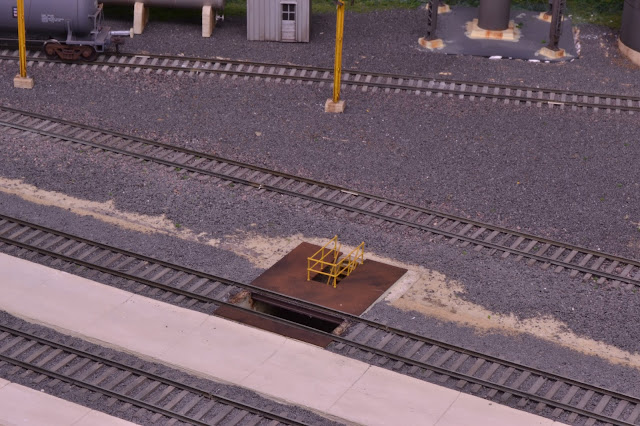
Next up is the inspection pit. The base for this is an ash pit that was part of a craftsman kit that my Stepfather built many years ago. I still have the ash conveyor and if I ever get around to back-dating to steam, I'll use it here. My original plan was to simply cover the pit with styrene and weather it to look like steel plate. Then I got the idea of an inspection pit. In checking some photos taken by Everett Young of the C&O engine service area at Martin, KY, there appears to be a yellow railing around a small section of one of the tracks. It certainly appears to be an inspection pit of some type. The railing are from Tichy as are the stairs to the pit.

While studying the photos of the Martin, KY yard, I noticed a small, red box on the side of the station. Speculating again, it appeared to be a fire extinguisher box of some type. The Atlas GP38 and GP40 come with a small equipment box of some type. I've never found an explanation for exactly what it's supposed to be, but it sure looked like it could make a neat fire extinguisher box. The only challenge would be finding decals small enough to label it. Then along comes Robby Vaughn who seems to be able to create just about anything, from cast resin 60 ton L&N hopper cars to decals so small you can't read them. He put together a great set of "FIRE" label decals and you can see some of them in the photos below.
And while he was at it, Robby also made a great set of mailbox decals. The mailboxes are by Korber and were painted and lettered based upon a photo taken in the 1960's. Robby got the pick-up time on the small white schedule wrong, but I don't think anybody will notice...
And last up is a quick update on scenery. The bridges at the engine terminal are finally under way and the photo below shows the progress so far. This is one of the last major scenery projects on the railroad and will take some time to complete. The first objective is to get the bridges in place so that operations can resume. More to follow on this project.
I stumbled across "The Position Light" bog earlier this morning and was amazed at all of the information it contains regarding all aspects of railroad signalling. I was searching for locking devices on CTC panels and a picture of Amtrak's THORN Tower appeared in the images page. Here's a link to the blog post: http://position-light.blogspot.com/2011/12/amtrak-thorn-interlocking.html. There's an incredible wealth of information in this post on the operations of THORN Tower along with a large number of photos and diagrams. And the home page for the blog is now listed in the Great Railroad Modeling Sites panel on the right of this blog, too. Absolutely great stuff!
For those of you who have interest at all in railroad signals, spend a little time on this blog.
As each new group of signals is installed and new blocks are wired, I have to go back and change the spreadsheets for the signal input for the previously installed signals. The last signal along the line before an unsignaled section of track is always set to Red over Yellow, or restrictive. Once additional signals are installed, the aspects for this last signal need to be changed to reflect the new configuration of blocks and signals. Other signal inputs also have to be changed to reflect the new configuration.
During the last operating session, I asked the crews to report any aspects that weren't displaying what was observed in the field. Due to the recent installation of the signals and blocks at the west end of Nelsonville, I had changed a number of inputs to various signals and wanted to confirm whether or not they were working correctly.
As Robby Vaughn brought COXE 532 down the mountain from Summit Springs to Nelsonville, he encountered a Stop signal at BA Cabin. Train NMMT-5 was on the main clear of the turnout which was lined for the yard. Robby should have had a Red over Yellow, or Restricting, giving him permission into the yard. The photo below shows the approximate location of NMMT-5 when Robby approached BA Cabin.
It quickly became apparent that the locomotive on NMMT-5 had run into the block that included the turnout to the yard from the main (far left side of the picture above). Of course, the engineer on NMMT-5 was none other than the infamous Smokey Doll who just happened to have spent his entire career on the SOU and NS. There was no convincing him that he had overshot the signal. Which, of course, he hadn't. The problem was the position of the signal relative to the block.
In the picture below, engine 3017 is just short of the start of the next block. The red arrow shows gap between the blocks.
As I don't want to place the gap for the block anywhere in the turnout to the siding before the signal, I need to move the signal. And in order to position the signal head to the right of the track it controls, I'll have to build a signal bridge for this location and place it to the right of the siding where indicated by the arrow in the photo below.
The good news is that I can use the current signal at the east end of Nelsonville to control the westbound entrance to the yard and the junction with the Dry Fork Branch. The bad news is that I need to build another signal bridge.
Fortunately, I have a supply of signal bridges on hand and the need to build one for this location has provided the inspiration to build the one for the east end of Nelsonville that will control eastbound movements on the main and the Dry Creek Branch. And that, in turn, has provided the inspiration to build the signal controlling the entrance to the main from the Dry Creek Branch. With any luck, we'll have the eastern half of the railroad signaled in the not too distant future.
It was about mid-way through the last operating session when I noticed that the rascals had showed up. As I walked into the railroad room from the crew lounge, I spotted an odd sight at the end of the west staging yard. It appeared that someone had set up a new spur complete with a building and a car spotted at it. A closer observation revealed what you see in the photo below.
The infamous K&LE horse car had arrived on the CWE and was spotted at a to-be-named industry. The horse car is the work of the illustrious John Miller and he was the one who found the "building" back in the workshop.
Before the session started, we had talked briefly about the whereabouts of the horse car. When last seen, it was headed westbound on the CSAO of Deb and Matt Snell. It has also been spotted on the FPS and the DP in the recent past.
There are several individuals who can't be trusted to be alone in any railroad room. I won't name names, but the creator of this car is the ring leader and the guy behind the FPS has been known to be his able accomplice...
The holidays are here and the end of 2015 is rapidly approaching. There are a lot of projects in the works on the railroad so I thought I'd provide a quick update on recent activity.
The new panel design has been finalized and the first one is shown below. As I've mentioned before, the new panels will utilize route selection versus turnout controls. This should simplify operation for the crews as some have found the toggles confusing. The system will be run by the Route Control System (RCS) developed by Gerry Albers and sold by his Signals By Spreadsheet company (http://www.signalsbyspreadsheet.com/). More on this later. The new panels will be printed on Avery full sheet labels, given a light coat of clear gloss to protect them, and then mounted directly on the existing panels.

There are five signals in the vicinity of Big Chimney that either aren't visible from the aisle or are difficult to see. The solution to this is to provide repeater signals on the panel. Holes will be drilled and LED's installed in each of the targets on the panel which in turn will mirror the aspects in the field. Four of the repeater signals are on the Big Chimney panel and the fifth will be on the Cedar Falls Jct. panel. While this sounds great is concept, it requires wiring another complete signal for each one repeated. Needless to say, I'm glad there are only two other signals on the railroad that will require this setup. The photo below shows the repeater signal terminals wired up and awaiting the leads from the LED's.

The first RCS card has been installed and is shown in the photo below. It can control up to eight turnouts. Also shown to the left of the RCS card are the Tortoise drivers (TD8's) which are wired directly to the switch motors and control their movement based upon input from the RCS card.
After the next op session, all the toggle switches will be pulled and the Tortoises will be wired to the TD8's. One of the SPDT switches on each Tortoise will be used for power routing for the frogs and all of this wiring is now in place.
The next photo shows the current mock-up for a portion of the CTC panel that controls Big Chimney. The panel itself will be in the crew lounge outside of the layout room. Part of the beauty of the SBS system is that there will only be one wire between the layout and the panel.
In addition to the signalling project, the scenery around the caboose service area is just about complete. Some more vegetation will be added along with some additional details.
The rails have been put down in the roundhouse and the two radial tracks although they haven't been wired yet. The walls are being held in place temporarily with small blocks of wood. I haven't decided yet just what I'm going to do with all of the doors and windows.
And the two N&W SD35's that see regular service on the Nelsonville Turn are in the shop being completely stripped and cleaned. They'll get Tsunami decoders and sugar cube speakers along with some weathering before going back out on the railroad.
There are a number of other projects in the works, including another SD40 and a two-bay hopper car for sand service that are in the paint shop, the fuel unloading cranes, a pump house for the diesel fuel service area at North Pierce and some additional small detail items like mailboxes and fire extinguishers.
More progress to come in the new year, but for now, I hope everyone has a very Merry Christmas and a great 2016!


