I finally bit the bullet and picked up video camera. While crude by any standards, as I certainly have a lot to learn about everything related to video, I thought it would be fun to post a few videos. So here goes. First up, COXL 41 heads east out of Logan Tunnel just after leaving Hollister Yard at North Pierce, WV.
Next, COXL 41 continues its eastward trek, rolling through Big Chimney, WV. The train is about to tackle the 2.5% grade up to State Line Tunnel and the border between West Virginia and Virginia at Summit Springs.
COXL 41 exits Camp 3 Tunnel above Big Chimney and heads up the grade to Cedar Falls Junction and State Line Tunnel.
Last up, COXL 41 is passing the signal that controls the approach to Cedar Falls Junction where the Sand Fork Branch leaves the main line.
Video seems to be even more unforgiving than photographs, as you can see every little twist and bump in the track work along with any problems related to the rolling stock (such as the leaning hopper car). But that can prove to be useful in finding problem areas before they crop up in an operating session. This first foray into video has been fun, and I'm looking forward to learning more about all the cool things you can do with this medium.
Over the past week I have managed to make some progress on the changes just west of North Pierce, WV on the layout. The picture below shows the cardboard webbing in place and ready for the hardshell.
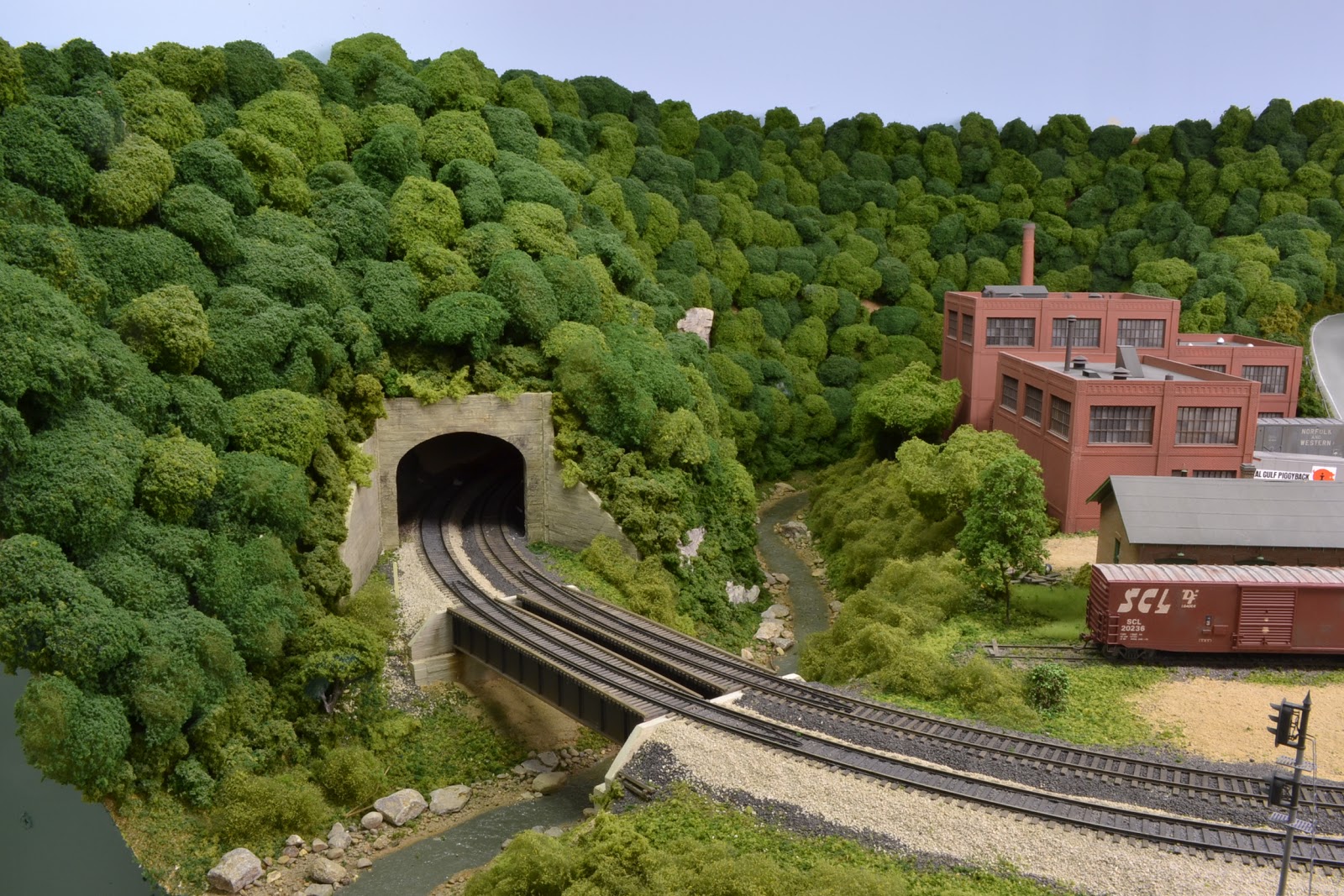
The tunnel has received the first application of weathering and the bridge and abutments are complete.
Yesterday I was able to get the plaster cloth laid on the webbing and it's now ready for the Structolite.
I have also made some progress on the west end staging yard. The benchwork is complete and ready for Homasote.
In the photo above, you can see the Nelsonville Turn staged on the Wilson Bridge Branch in the background. When Anthony Hardy, one of the regular members of the operating crew, saw this photo, he commented that it looked like the same train that was staged there at the last op session. That's because we didn't get to run this train during the last session. Stuart Thayer, the regular yardmaster at Hollister Yard, refused to report for duty because management didn't provide any M&M's to the crew. As a result, we were short-handed. And if the rest of the crew had spent as much time running trains as they did eating chocolate chip cookies...
The April edition of Model Railroader magazine features Bill Doll's proto-freelanced Forest Park Southern. It's a beautiful layout set in West Virginia in the mid- 1950's with numerous coal trains and trackage rights for C&O trains over a portion of the layout. Here's a link to the Model Railroader website where you can view a preview of the issue: http://mrr.trains.com/en/Magazine/Current%20Issue.aspx. If you are a subscriber to MR, there is also some video footage of the layout in the MRExtra section of the website. I have had the privilege of operating on Bill's layout several times, and it runs as good as it looks. And while the pictures in the article are great, they really can't do justice to the beautiful work that Bill has done, from the scenery to the settings to the CTC controlled signal system. The Forest Park Southern is truly an outstanding model railroad.
This past week I spent a bit of time working on the modifications to the layout at North Pierce. In the first photo you can see the first section of new hardshell and the trees that have been replaced in this area. As I have mentioned before, the trees on the hillside here were part of the first scenery completed on the layout. Some were left over from my first layout, and at the time I was only using two colors of ground foam for the foliage. This looked OK initially, but really looked bad in photographs.
The second photo shows the new track in this area, all of which is operational now. I added cardboard to the sides of the hole in the drywall to keep any dust from getting on the track. I painted the cardboard, the Homasote, and the plywood with black poster paint in order to make it less visible from the tunnel entrance.
In the photo below you can see the location of the new bridge on the mainline. Once the tunnel portal is weathered and in place and the bridge and abutments have been added, I'll finish roughing in the scenery in this area.
It's good to have all of the demolition behind me- I hate the mess that it creates. And I'm really looking forward to seeing the first train come through the tunnel heading eastbound!
From the time I developed the concept of the Chesapeake, Wheeling & Erie Railroad, it was always my intent to have F units on the roster. In fact, the fourth engine I built for the CWE was an old Athearn F7 A unit. A number of years ago, I ordered two BLI F units- an A and a B- both with sound. I built the B unit first, and it sat as a lone unit for some time. Both engines had early versions of QSI decoders in them, and I was never happy with the sound. Once I began operating the layout, it seemed like it was time to build the A unit and pair it up with the B and a GP7 or 9 for mine run service. This past fall I finally finished the A unit and replaced the decoders in both F units with Soundtraxx sound decoders. Even the earlier versions of the Soundtraxx decoders sound much more like an EMD 567B than the QSI decoders. The units ran through two operating sessions before finally getting the final weathering. Now both units are finally finished, and here's the result:
In the photo above, F7A 1563 and F7B 1572 are shown at the engine terminal in Nelsonville. In the photo below, the units are rolling off the Dry Creek Branch and onto the main line heading west.
In the next shot we catch the trio coming off the bridge just before Cedar Falls Junction.
After passing through Cedar Falls Junction, the trio of units stops on the truss bridge over the main line at Big Chimney while the brakeman aligns the switch for the Sand Fork Branch. A westbound coal train sits in the hole at Big Chimney beneath the bridge.
After picking up the brakeman, the three units head out across the bridge that will take them up the Sand Fork Branch to serve the various tipples located along the line.
With the sunlight fading quickly, we catch one last glimpse of the trio as they pass the station sign at Irma, WV.
On the workbench are two more F7A's, and these units will round out the F unit fleet on the layout. Both engines are Intermountain shells on Stewart chassis with Kato drives, and both units have Tsunami's and high bass speakers installed. I'm anxious to get these two on the layout to hear the Tsunami's!
Over the past year or so I've made references to the new west end staging yard and the scenery that is going to be re-done at North Pierce. Well, the process has begun. The photo below shows the first load of lumber for the new staging yard. It will be a 12 track, stub-ended yard and will run along the wall on the right hand side of the photo back to the stairs.
The next photo shows where the yard throat will curve toward the layout room, the entrance to which can be seen toward the upper left hand corner of the picture. Also visible in the photo is the lift-out section across the sliding glass door that carries traffic from the layout room on the left to the 12 staging tracks on the shelves to the right.
This past Friday I finally got the motivation to start on the project. in just under two hours, almost all of the initial scenery removal had been completed. Below are the before and after shots of the area.
As you can see from the photo above, the first thing I found when I removed the drywall where the line was going to go through the wall was a stud. I'd forgotten how much fun this part of layout construction can be. At least it wasn't a water pipe. After reviewing the plan for the turnouts in the yard throat that had already been drawn, it became apparent that I could push the entire throat back several inches without any problems. This meant I could move the entrance to yard several inches to the right and avoid taking out a section of the stud. This isn't a load-bearing wall so removing a portion of the stud wouldn't have had any impact on the structural integrity of the house, but I wanted to avoid this if possible. The photo below show the new approach to the staging yard.
The main line will cross a 50' deck girder bridge over a small stream that will curve around and disappear behind a hillside that will be in the middle of the photo. The photo below shows how the main line will curve slightly after crossing the bridge as it enters the staging area in the other room.
The slight curve will actually make it more difficult to see through the tunnel, an added benefit as there will be no scenery on the other side. The arrangement has worked out much better than I originally anticipated. If I can't be good at this kind of planning, I'll take being lucky! And with a little additional luck, I might even have some new staging track in place by the next operating session.
Over Christmas I received a special boxcar. Santa Claus (in the form of John Miller) gave me a 50' double pludoor boxcar painted for his free-lanced Kanawha & Lake Erie along with a set of home road decals. He also included loading destination information for waybills based upon the industries that his railroad serves. Below is the completed model ready for the next op session.


.JPG)
.JPG)
.JPG)



.JPG)
.JPG)
