Over the past few weeks, I have added some finishing touches to several areas of the layout. I installed some black skirting at the bottom of the fascia from just east of Big Chimney, WV around the isle to Logan, WV. The material was purchased at Banasch Fabric Outlet and is held in place with wooden clothes pins. I used a hot glue gun to fasten the clothes pins to the back of the fascia and the bottoms of the control panel and bill box support boards. All of this took about two hours, including the 40 minute trip to the store and back to purchase the material. Here's a look at the finished product.
I also found a permanent (at least I hope) solution for the bill box labels on the layout. As a short-term solution, I printed up the names of the locations represented by the bill boxes on Avery labels and applied them to each box.
For the permanent solution, I printed up the same Avery labels but used a white font with a black background. I think this looks a little less obtrusive but still allows the crews to be able to read the labels clearly. I inserted the labels, without removing the backing, into 3 1/2" clear file tabs and then trimmed the tabs to fit the lael. The tabs were spray painted with a matte finish prior to installation on the bill boxes in order to reduce the reflection from the lights.
The last addition was a schematic drawing of the layout that was mounted at each town, yard and junction. I got this idea from Bob Bartizek and his beautiful Pennsylvania & Western layout which you can see here: http://www.pennwestrr.com/. The schematic drawing helps the operators know where they are on the layout in relation to other locations on the layout.
These finishing touches have really improved the overall look of the layout and will hopefully help the crew feel more comfortable when operating the layout.
It took much longer than I anticipated to finish the scenery at SJ Cabin. I got caught up in a number of other projects, including several operating sessions on the layout and operating on a number of other layouts in the area. But here are some shots of the finished area.
Switch stands have been added, ties have been placed between the rails on the main and the yard lead so that the MofW Department can get the speeders out, and some rusty barrels have been added next to the signal maintainer's shed.
A scratch-built oil tank has been added behind the cabin and an electric switch motor now provides dispatcher control of the siding at Hollister Yard. There is also some subtle weathering on the ties at the switches to represent oil stains.
Some tie plates by Monster Model Works have been added next to the section house along with some ties and a speeder trailer.
And lastly, shot of the area with a coal empties extra leaving Hollister Yard. The real payoff for all of this work is when you finally get to run some trains through the scene!
I finished a small truck dump tipple for Big Chimney, West Virginia this past weekend and thought I would post a few pictures. The structure is based on two tipples on the Clinchfield Railroad. The first is a small truck dump tipple located at Haysi on the Clinchfield Railroad. There are some great shots of this tipple in Bob Helm's book titled "The Clinchfield Railroad in the Coal Fields" that were taken by Everett Young. The second is a small tipple that was located at the south end of Dante Yard. You can see a photo of the tipple at Rob Wolshlager's Clinchfield Country website here: www.clinchfieldcountry.com. The structure was scratch-built using styrene shapes and strips, Plastruct shapes, stripwood, and Campbell Scale Models corrugated siding.
.JPG)
.JPG)
Construction took a lot longer than I thought it would, but as the structure sits between the main line and the fascia, I wanted it to be a fairly detailed model. You can see some in-progress photos here:http://cwerailroad.blogspot.com/2012/04/progress-on-truck-dump-tipple.html.
Here's a shot of the overall scene.
The crews that work the Big Chimney Roustabout should now have a better idea of where the empty hopper cars should be spotted.
The track plan for the layout is shown in the stone age drawing below. When I drew the plan back in the early 1990's, I used HB lead because it was easy to erase. That made the drawing too light to scan, so I eventually went back and re-traced it with darker lead. It's still pretty rough, but it depicts the basic layout and features of the railroad. I've made several attempts to draw it with some of the layout design software that's available now, but it always ends up being a lot of time and effort for something that's already complete.

The Chesapeake,Wheeling and Erie is a small class 1 railroad that runs from Erie, PA to coal docks on the Chesapeake Bay. The railroad was constructed primarily as a coal hauler to take coal from the mines in West Virginia and Pennsylvania to Great Lakes and Tidewater ports (think Virginian). The line runs south from Erie, PA, has a branch that goes to Wheeling, WV and one that runs east to Pittsburgh, PA, and then heads into West Virginia. The layout represents a portion of the line from approximately Thomas, WV to New Market, Virginia. The main line then runs through Virginia to the Chesapeake Bay. The "Central Belt" moniker comes from the geographic location of the railroad.
The layout is point-to-point with two 6-track staging yards (one above the other) located in an adjacent room. The main line enters the layout from New Market (staging) and the first stop is Nelsonville, VA. There is a small yard here along with an engine servicing facility. Two branch lines leave the main here: the Dry Creek Branch and the Wilson Bridge Branch. The Wilson Bridge Branch Branch serves as the yard lead for Nelsonville and proceeds into staging. The Dry Creek Branch actually connects to the other side of the layout by running through hidden track around the perimeter of the room (more on this design flaw later). There is a connection between the main and the Dry Creek Branch that serves as a wye to turn equipment. The photo below shows the yard at Nelsonville with the main line at Summit Springs running up above the yard.
After leaving Nelsonville, the main line continues to Summit Springs where a large coal preparation plant is located along with a smaller tipple. You can see photos of the prep plant on this post: http://cwerailroad.blogspot.com/search?updated-min=2011-01-01T00:00:00-05:00&updated-max=2012-01-01T00:00:00-05:00&max-results=5. Many of the locations on the layout can be seen on previous posts. The main line then crosses the Dry Creek Branch and punches through the summit (backdrop) to the other side of the mountain.
At Sand Fork Junction, the Sand Fork Branch leaves the main and heads up the holler to serve three separate mines and a team track. The main line continues from the junction down the 2.5% grade to Big Chimney, WV. There are several industries and two coal load-outs located here. The Elkwater Branch also leaves the main and enters a two-track staging yard that connects back to the main at Petersburg Junction. After leaving Big Chimney, the main line crosses under the Sand Fork Branch and continues to Petersburg Junction, where the Purgettsville Branch comes in from staging. The main line then continues to Hollister Yard at North Pierce, WV.
Hollister Yard serves as the coal marshalling yard for all of the mines and load-outs west of Sand Fork Junction. The yard includes an engine service facility at one end and a car repair facility, including two RIP tracks, at the other end. Numerous mine and branch runs are dispatched from Hollister Yard, and way freights make set-outs and pick-up here. There is also a local yard job that services the industries in and around North Pierce.
After leaving North Pierce, the main line enters staging and runs around the perimeter of the room to connect with the Dry Creek Branch. There is a 6-track staging yard along the wall beneath the main line and Sand Fork Branch that is all but inaccessable now. Hidden staging is great, as long as it is easily accessable. Cars will derail, track will move and things will need to be cleaned/checked regardless of the care taken during construction.
The 6-track staging yard that is now unusable will be replaced with a 12-track staging yard that will be located in the other room and will represents locations and connections to the west. The main line will leave North Pierce on a single track and will punch through the wall to staging. The two bridges will be removed and the scenery will be re-done in this area. This will fix another problem with the layout- I absolutely cannot reach the scenery at the back of this area, even with a creeper. I have no idea what I was thinking when I built the scenery so deep here.
The other two 6-track staging yards will now be used for connections to the east and the Wilson Bridge Branch. My friend Stuart Thayer has been scheming to have a run-through freight from some foreign road connection come on the line from this branch along with some foreign road power to jointly switch the tipple at Nelsonville. A lot of new ideas for operating the layout have come out of the recent operation sessions, and I'm excited about the possibilities for expanding operations.
The Chesapeake, Wheeling and Erie Railroad held its second operating session this past Saturday. A few new trains were added to the schedule and the gremlins were held at bay for the most part. But most importantly, everyone had a good time. We dispatched using track warrants, which are a little too new for my era of the mid-1970's but work really well for the current set-up. We use car card and waybills as shown in the photos below.


I also included a train card which provides information about the specific movement such as origin, destination and work to be done. To assist crews in spotting cars, I'm using the Train and Industry Blocking System, or TIBS, that Dan Holbrook developed for the Midwest Railroad Modelers layout back in the late 1980's. The system uses alpha numeric codes for blocking trains and spotting cars on the layout. You can see the code in red in the upper left hand corner of the waybill. There is a corresponding alpha numeric code on the panels on the layout for each of the on-line industries. Several crew members commented on how helpful the codes were, especially since everyone is new to operating the layout, myself included.
The schedule included eight trains: 1) an eastbound and westbound way freight which made set-outs and pick-ups; 2) the Elkwater Branch turn that comes from staging into Big Chimney, WV, makes set-outs and the proceeds to the yard at North Pierce, WV; 3) the Dry Creek Roustabout that leaves staging and enters the small yard at Nelsonville; 4) a westbound coal extra with empties; 5) an eastbound coal extra with loads; 5) the Big Chimney Roustabout, which runs from North Pierce to Big Chimney and back as a local turn; 6) the Sand Fork Mine Run, which works the tipples on the Sand Fork Branch; and 7) the Nelsonville Yard Job, which classified cars coming off the Dry Creek Branch and assisted the way freights with set-outs and pick-ups.
In the photo below, Stuart Thayer has taken the SD40/SD40-2/SD40 lashup from COXE42 to the "house" at North Pierce.
Next up, Anthony Hardy is getting ready to bring the Dry Creek Turn into Nelsonville.
And in the photo below, Bill Ford and Ron Parrish have just brought the Elkwater Branch Turn into Big Chimney and have set-out two wood chip hoppers on the Helper track.
The four turnouts that were replaced after the last session worked flawlessly. It took a bit of time to get the layout ready beforehand, but that time will be reduced as the layout is operated more frequently. Improvements for the future include OpSig aprons to hold car cards and such, a yard master position for North Pierce, a second coal train to be staged at North Pierce at the beginning of the session, and a dispatcher that can keep the order of the trains straight (that would be me). All in all, it was a great time, and it was really inspiring to see the layout in action. These operating sessions could be habit forming...
The Chesapeake, Wheeling and Erie Railroad finally held its first ever operating session, and it was a blast! Good friends Stuart Thayer, who has been instrumental in developing the operating scheme on the layout, and Jim Rollwage (you can see Jim's beautiful Denver Pacific layout on YouTube here: http://www.youtube.com/watch?v=VMUCKyocX-4) came over and Stuart brought Anthony Hardy with him from Lexington. Stuart and Jim have been involved in operations for over 30 years, and Anthony's layout appeared in the 2003 edition of Model Railroad Planning. Given the level of knowledge and experience of the group, I was a bit nervous to say the least. All in all, though, the session went fairly smoothly.
The layout currently has only one staging yard in operation, so the plan was to run six trains: 1) Way freight Train 304 (staging to the yard at North Pierce); 2) COXE 42- coal empties from staging to North Pierce; 3) The Big Chimney Roustabout (local from North Pierce to Big Chimney, WV and back; 4) Sand Fork Mine Run (empties from North Pierce to the tipples on the Sand Fork Branch and loads back to North Pierce); 5) Way freight Train 205 (North Pierce to staging); and, 6) COXL 51- coal loads from North Pierce to staging. I served as yardmaster/dispatcher and we used track warrants for train movements. The session took about 2 1/2 hours, and everybody appeared to enjoy themselves.
As expected, the gremlins showed up and almost wrecked the session before it even started. The morning of the session I turned on the layout only to get a short buzzer from the CVP Zone Master at North Pierce. I spent the next two hours tracking down the short, which resulted from the closing of a gap at the frog on one of the turnouts in Hollister Yard. On visual inspection it appeared to be o.k., but once I re-cut the gap everything was fine. Once the session got started, the two old Atlas switches at the entrance to staging acted up, shorting when the six axle diesels crossed them. They have both been torn out and are being replaced with hand-laid turnouts. And the two commercial switches on the main at either end of Big Chimney acted up. The closure rail on the curved turnout at the west end wouldn't stay in gauge (I spent two hours the previous day trying to fix the power in the frog on this turnout) and the turnout at the east end shorted when diesels took the diverging route. Both of these switches will be replaced with hand-laid turnouts before the next session. The rest of the layout performed very well, and I was pleased that there weren't more issues.
This was only the second time that I have ever operated on a layout, and I quickly realized what I've been missing. It was even more fun than I anticipated and I can't wait until the next session. And I've got to thank Stuart for getting me an invitation to operate on Jim's layout. That was the first time for operations for me, and Stuart and Jim couldn't have been more patient and helpful. Talk about a great introduction into another aspect of this amazing hobby! And there will be photos to post from the next session.
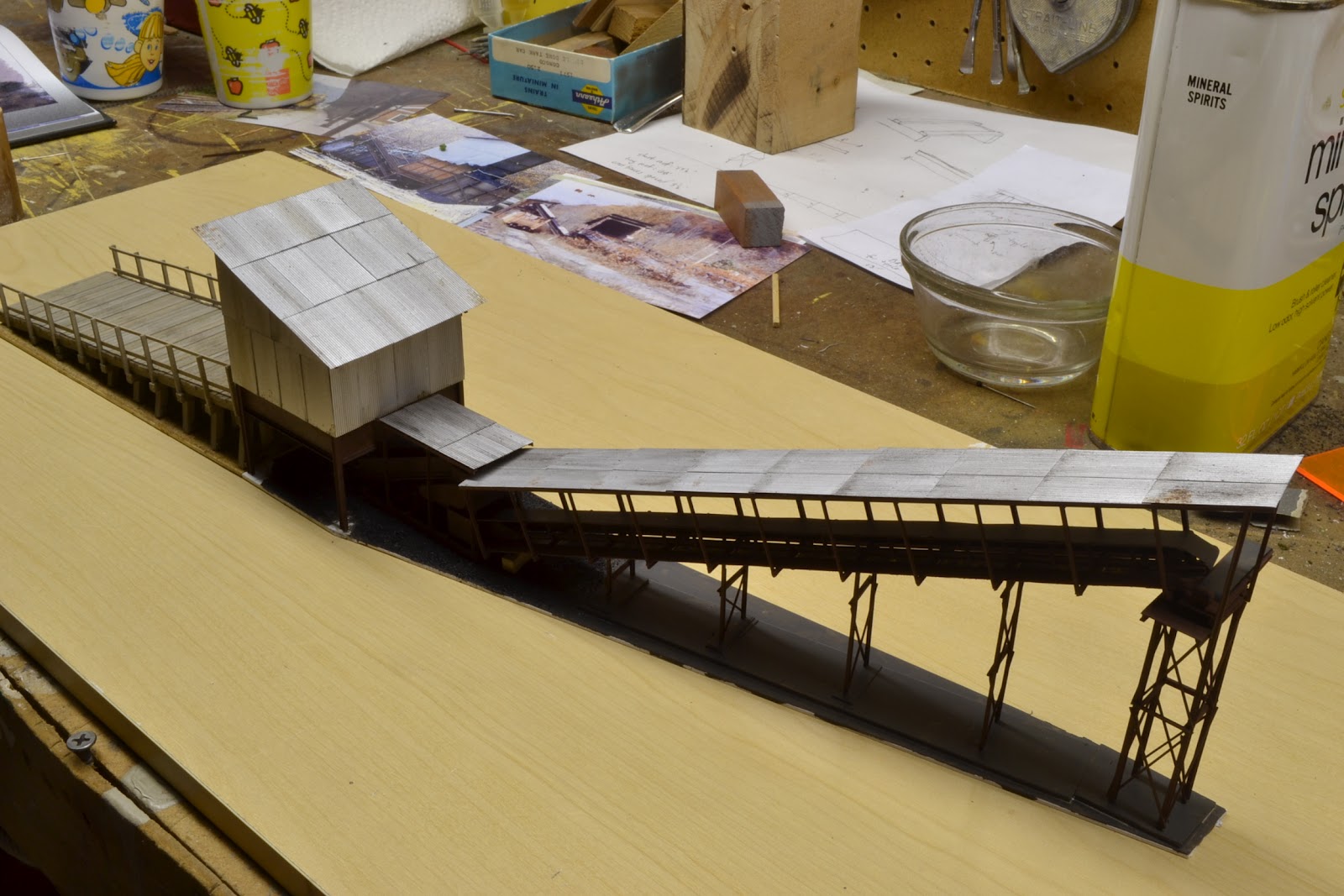
Last night I finished the basic construction of the small truck dump tipple that will be located at Big Chimney, WV on the layout. The receiving bin structure still needs to be glued to the base and coal added around the legs. Once that finished I'll set the structure in place and complete the scenery in the area.
This project has taken a bit longer than I thought it would and I'm anxious to get it finished. There are a number of other projects that I'm itching to get started on.

.JPG)
.JPG)
.JPG)
.JPG)
.JPG)


.JPG)
.JPG)
.jpg)


.JPG)
.JPG)